Insight
Automating Road Intelligence: End-to-End AI Pipeline for Highway Data
Published on April 25, 2026
Modern road survey systems generate massive amounts of data from sources like GPS devices, LiDAR sensors, and high-resolution cameras. This data captures detailed information about road conditions and assets such as signboards, guardrails, and lane markings. Traditionally, managing this data involves multiple manual steps, including organizing files, running scripts, and verifying outputs, which becomes slow and error-prone for large projects. An AI-driven end-to-end pipeline simplifies this process by automating data handling, improving efficiency, accuracy, and scalability in road infrastructure monitoring.
AI Pipeline for Data Processing and Asset Detection
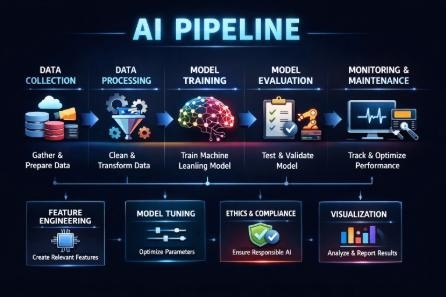
The pipeline begins with data ingestion, where raw data such as images, videos, GPX logs, and metadata is collected from cloud storage or local systems. Automated tools process different formats like CSV, JSON, and image files, storing them in a centralized database. In the preprocessing stage, the system organizes data, extracts key information, and standardizes coordinates. Using geospatial techniques and GIS tools, survey points are mapped accurately through chainage, ensuring precise location tracking. The next stage involves AI-based analysis, where computer vision models detect road assets like signboards, barriers, cracks, and markings from survey images. These detected assets are then linked with GPS and chainage data for accurate mapping.
Data Validation and Scalable Insights

To maintain reliability, the pipeline includes automated quality checks that verify asset counts, detect missing data, and flag inconsistencies. This reduces the need for manual validation while ensuring high data accuracy. Once validated, the processed data is stored in structured databases and integrated with dashboards and reporting tools. These outputs provide clear insights for engineers and decision-makers, helping them plan maintenance and manage infrastructure effectively. Overall, AI-powered pipelines transform complex workflows into streamlined processes, enabling faster, more accurate, and scalable management of road networks.