Insight
SSD vs YOLO – A Friendly Guide to Object Detection
Published on January 06, 2026
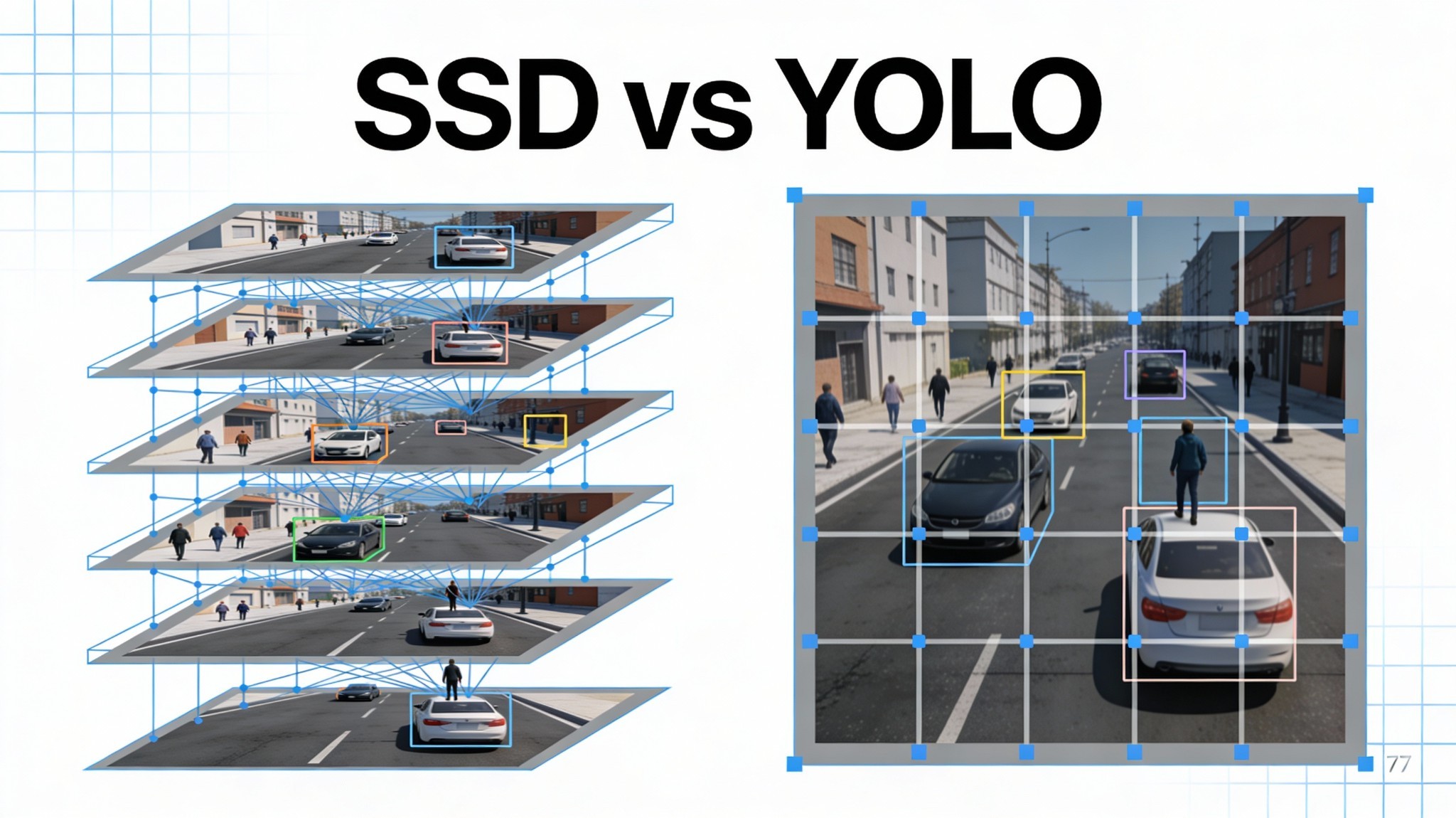
YOLO (You Only Look Once) views object detection as one end to end prediction problem. The image is divided into a grid, and each grid cell predicts bounding boxes and class probabilities at the same time. Because the whole image is processed in a single forward pass, YOLO is famously fast and ideal for real time work.
SSD (Single Shot MultiBox Detector) also predicts boxes and labels in one go, but it uses several feature maps at different scales. This multi scale strategy helps SSD recognize both tiny and large objects more reliably, leading to a strong balance between speed and accuracy.
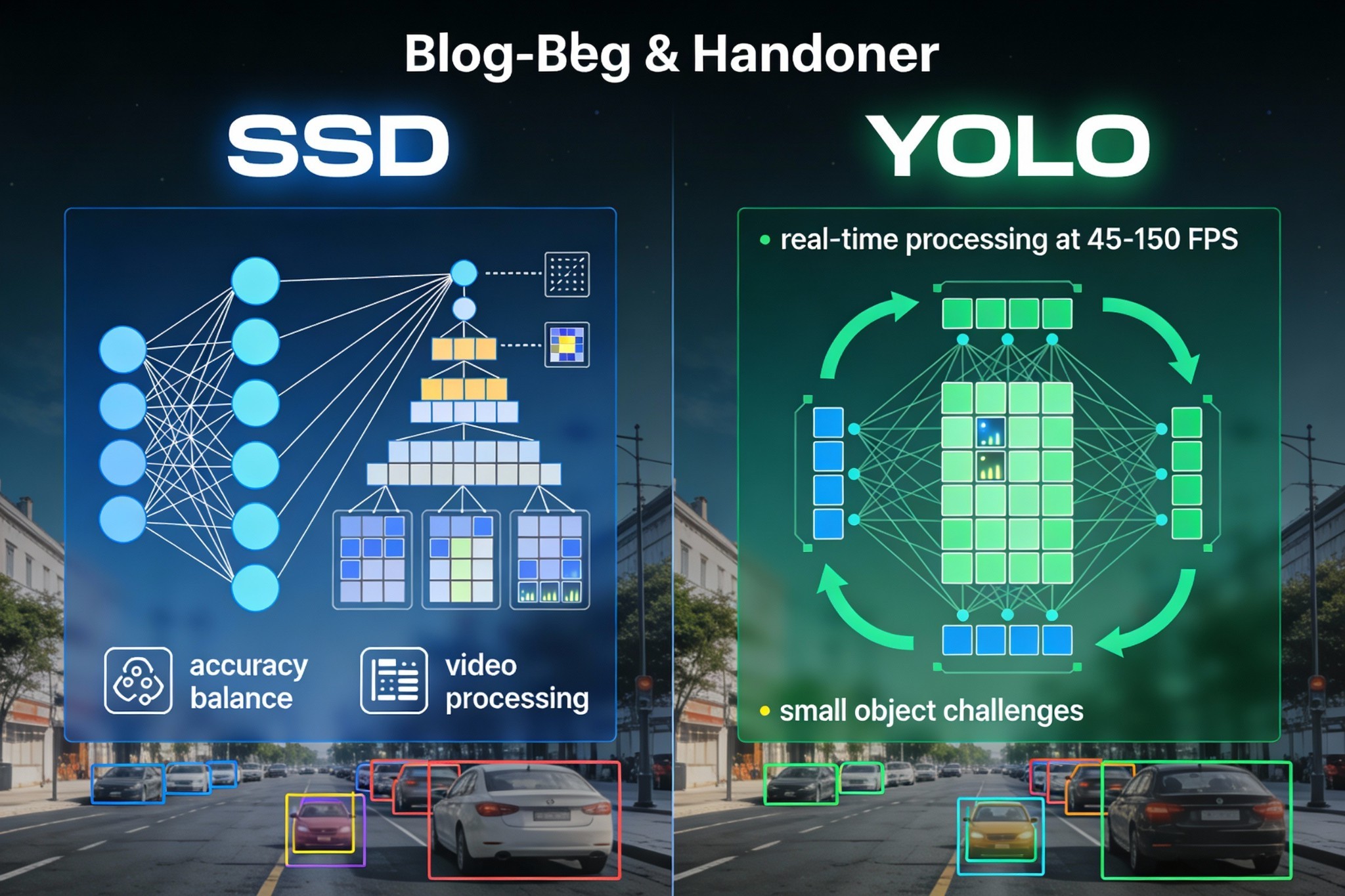
YOLO (You Only Look Once) works by making grid-based predictions across the entire image, allowing it to localize and classify objects in a single pass. Each grid cell can predict multiple bounding boxes, which helps YOLO detect several objects at once, even in busy scenes. One of its biggest strengths is real-time processing the model is designed for speed, making it ideal for applications where fast decision-making matters. All of this is achieved through a simple, unified architecture, which keeps the model efficient and deployment-friendly
SSD (Single Shot MultiBox Detector) performs multi-scale detection using several feature layers within the network, meaning it can recognize objects of different sizes more effectively. It relies on predefined “default” boxes with different aspect ratios and shapes, enabling it to match objects more accurately. SSD is well-known for maintaining an excellent balance between accuracy and speed, making it reliable without sacrificing performance. It is especially strong when detecting smaller or partially overlapping objects, which gives it an advantage in complex real-world scenes.
YOLO — Advantages
YOLO is widely appreciated for its exceptional real-time speed, making it a top choice for applications where rapid detection is critical. It generalizes well across many domains, meaning it performs reliably in a wide variety of real-world scenarios. Another key advantage is that YOLO typically requires lower memory and compute resources compared to many other detection models, which makes it easier to deploy on lighter hardware. Since YOLO processes the entire image at once, it also gains strong global context awareness, helping it understand object relationships within a scene.
YOLO — Limitations
Despite its strengths, YOLO can struggle when detecting very small or distant objects, as fine-detail recognition is not always its strongest area. It may also become less accurate in environments where objects overlap heavily, sometimes producing less precise bounding boxes. In certain scenarios, especially with motion blur or extreme viewing angles, YOLO’s predictions may become inconsistent. These trade-offs are generally acceptable in real-time systems, but they are worth considering for high-precision tasks.
SSD — Advantages
SSD performs particularly well when it comes to detecting small-scale objects, thanks to its multi-scale feature design. It delivers reliable performance in dense environments where many objects appear together, maintaining stability and accuracy. One of SSD’s biggest strengths is its balanced mix of speed and accuracy, offering strong detection performance without the heavy computational cost of two-stage detectors. Although there is a slight accuracy trade-off compared to some more complex models, SSD still provides highly dependable results in most practical applications.
SSD — Limitations
On the downside, SSD is typically slower than YOLO, especially in scenarios requiring extremely high frame rates. Larger SSD versions also demand more computational power, which can make deployment challenging on limited hardware. Fine-tuning SSD for best performance may require more expertise and experimentation. Additionally, it is not always the best fit for ultra-light edge devices, where minimal resource usage is essential.
👋 Hi! I'm Hanu AI

Hanu AI Beta v2.0
Your AI assistant